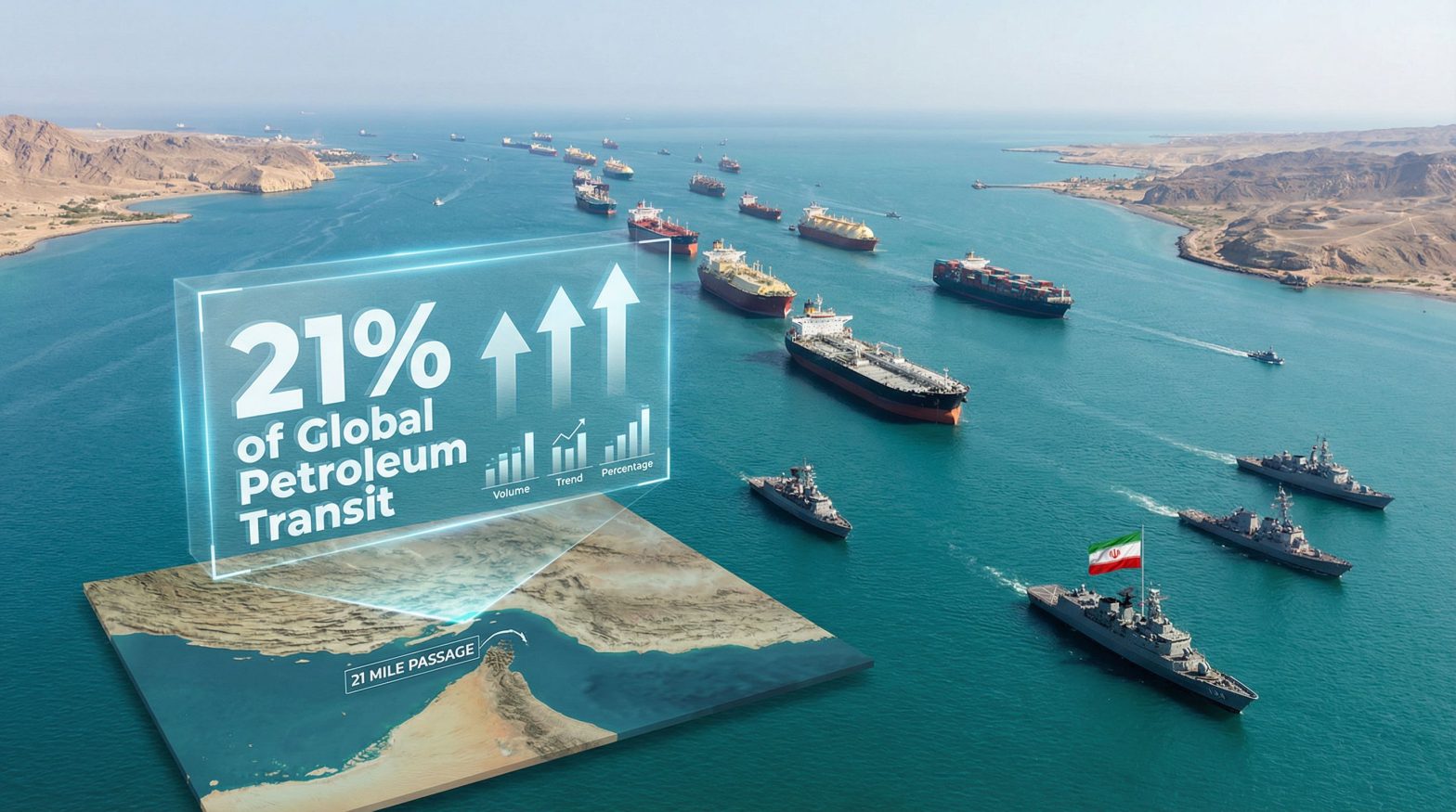
Quick answer: The Strait of Hormuz disruption, which began February 28, 2026, blocked roughly one-fifth of the world’s oil trade and a quarter of its LNG at its peak — the largest oil-market shock in history. But the economic impact is wildly uneven: energy exporters like Canada and Gulf-adjacent producers have seen revenue windfalls, while import-dependent economies across South Asia and Europe are absorbing the worst of the inflation and growth hit.
Why this needs a comparative lens, not nine separate stories
Nearly every business outlet has covered the Strait of Hormuz disruption from a single national angle — US gas prices, UK energy bills, Pakistani import costs. What’s missing is the comparative picture, because the economic effects of a chokepoint closure are, by definition, relative: some economies gain exactly what others lose.
The scale of the disruption
Until the conflict began, roughly 25% of the world’s seaborne oil trade and 20% of global LNG passed through the Strait of Hormuz (Wikipedia: 2026 Strait of Hormuz crisis). Iran’s retaliatory closure — using drones, ballistic missiles, mines and small attack boats — combined with a US blockade of Iranian ports from April 13 to May 29, 2026, pushed insurance costs for tankers transiting the strait to four to five times their pre-war levels, according to Congressional Research Service analysis (Congress.gov). Dallas Fed modeling estimated that a closure removing roughly 20% of global oil supply could push WTI crude toward $98 per barrel and cut global real GDP growth by an annualized 2.9 percentage points in the most acute quarter (Dallas Fed).
The losers: energy-import-dependent economies
Research from the Kiel Institute modeled the welfare effects of a full Hormuz closure and found the damage concentrated heavily in countries that simultaneously depend on imported energy, imported fertilizer, and have large agricultural sectors — a “bottleneck” running from energy to chemicals to fertilizer to food prices (Kiel Institute). Under a full closure scenario, the Kiel model estimated global energy prices would rise roughly 5.4%, with food prices up 2.7% — figures that roughly double if Saudi Arabia’s alternate export routes were also disrupted.
Among the countries covered in this batch:
- Pakistan was among the countries hardest hit, officially requesting Saudi Arabia reroute oil supplies through the Red Sea port of Yanbu to bypass the closed strait — a request Saudi Arabia accommodated with at least one rerouted shipment (Wikipedia: 2026 Strait of Hormuz crisis).
- The UK was flagged as likely to be the worst-hit major economy from the crisis over the medium term, according to broader crisis tracking, even though the initial disruption hit Asian economies hardest (Wikipedia: 2026 Iran war fuel crisis).
- Asian economies broadly absorbed the largest initial shock, since roughly 84% of crude oil and 83% of LNG passing through the strait in 2024 was destined for Asia, with nearly 70% of that going to China, India, Japan and South Korea (Wikipedia: 2026 Iran war fuel crisis).
The winners: energy producers outside the chokepoint
- Canada’s energy sector became the single largest contributor to national GDP growth during the crisis window, with Western Canadian Select crude trading more than 30% above its start-of-year level even as global benchmark prices declined from their peak — a dynamic detailed in our CUSMA analysis (BNN Bloomberg).
- US non-OPEC+ producers were projected to account for most non-OPEC+ supply growth globally, with output rising by roughly 0.5 million barrels per day to partially offset the regional shortfall (World Bank).
- Saudi Arabia, whose Red Sea and Indian Ocean pipeline access via Yanbu bypasses the strait entirely, was excluded from the direct shock in most modeling and continued exporting oil products even as Gulf neighbors faced disruption (Kiel Institute).
The recovery signal: tanker traffic and ASEAN
By mid-2026, easing oil prices and a recovery in Strait of Hormuz tanker traffic became explicit factors in Maybank’s decision to upgrade its Asean-6 GDP forecast — a connection explored in depth in our Malaysia GDP upgrade piece (BigGo Finance). That recovery is the clearest real-time indicator that the acute phase of the crisis is easing, even though the underlying conflict has not been fully resolved.
The takeaway for global business planning
The Strait of Hormuz crisis illustrates a broader principle worth building into any 2026 risk model: a single chokepoint disruption doesn’t produce a uniform “bad for the global economy” outcome — it produces a redistribution, often a dramatic one, between energy producers and energy importers, and between countries with alternate shipping infrastructure and those without it.
