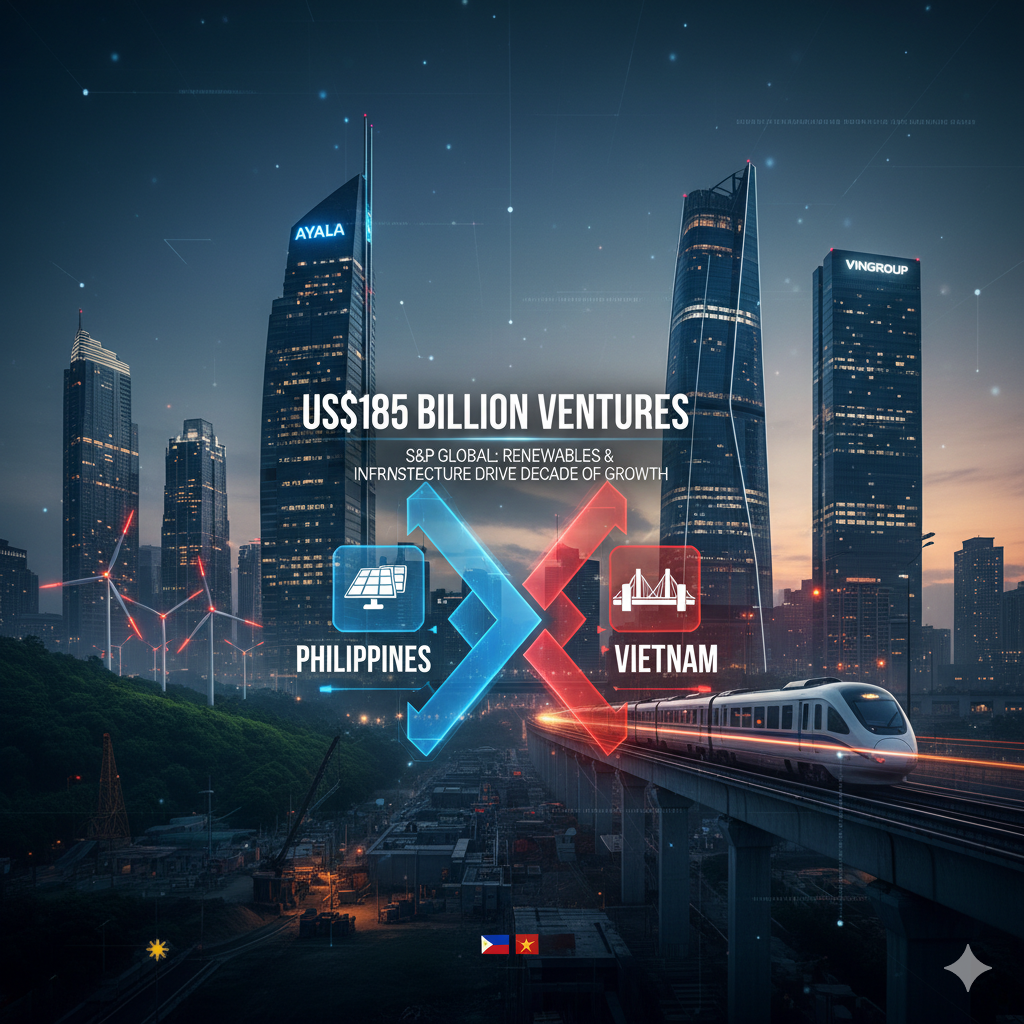
Southeast Asian Titans Unveil US$185 Billion Decade-Long Investment Spree
Conglomerates in the Philippines and Vietnam are set to embark on their “most demanding investment cycle to date,” committing a massive US$185 billion over the next decade to fresh ventures, primarily driven by strategic national goals in renewable energy and infrastructure. This significant finding, detailed in a report by S&P Global Ratings, highlights a major pivot by the region’s largest business groups towards diversification and high-growth, long-term sectors.
| Key Data Point | Fact-Checked Detail | Source Citation |
| Total New Investment | US$185 billion over the next decade (2025-2035). | S&P Global Ratings Report: “Philippine And Vietnamese Conglomerates’ US$185 Billion Pivot Will Test Capital Discipline,” dated November 5, 2025. |
| Scale of Investment | This is 2.5 times the conglomerates’ total capital expenditure over the last decade. | S&P Global Ratings / The Business Times (Nov 2025) |
| Sector Allocation | Nearly two-thirds of the total investment is earmarked for infrastructure and renewable energy. | S&P Global Ratings / The Business Times (Nov 2025) |
| Conglomerates Analyzed | Nine of the largest publicly listed conglomerates, including the Philippines’ Ayala Corporation, SM Investments Corporation (SMIC), and JG Summit, and Vietnam’s FPT Corporation, Hoa Phat Group, and Vingroup. | S&P Global Ratings / The Business Times (Nov 2025) |
Diverging Focus: Renewables vs. Infrastructure
While both countries’ business groups are pivoting toward these strategic areas, S&P’s analysis highlights differences in their primary focus:
- 🇵🇭 Philippine Conglomerates: The primary focus is heavily skewed toward renewable energy due to generally supportive government policies.
- Capacity Goal: Conglomerates in the study are expected to account for 40% to 50% of the Philippines’ renewable energy capacity by 2030.
- Specific Example: Aboitiz Renewables, a subsidiary of Aboitiz Equity Ventures, aims to grow its renewable energy portfolio to 4.6 gigawatts (GW) by 2030 from 928 megawatts (MW).
- Source: S&P Global Ratings / The Business Times (Nov 2025)
- 🇻🇳 Vietnamese Conglomerates: These groups are directing a larger share of their capital towards infrastructure development (estimated at 67% of their planned capital expenditure in new ventures).
- Specific Project (Vingroup): Vingroup proposed a multi-billion-dollar North-South high-speed railway project, estimated at US$61.3 billion, to upgrade the transportation network.
- Specific Project (Hoa Phat): Hoa Phat Group plans to invest US$550 million in specialized structural steel manufacturing, supporting national railway and construction projects.
- Source: S&P Global Ratings / The Business Times (Nov 2025)
Funding and Execution Risks
The report cautions that this “demanding investment cycle” will test the firms’ financial discipline, particularly in light of higher leverage among some Vietnamese groups.
- Funding Discipline: S&P highlighted a divergence in funding trends. Philippine corporates tend to rely more on cash flow from their core businesses for capital expenditure, while Vietnamese counterparts show aggressively rising debt-to-EBITDA ratios and higher refinancing pressures.
- Execution Risk: Ventures into new, technically complex, and non-synergistic sectors carry higher execution risks and long investment horizons. The agency noted that Vingroup’s electric vehicle arm, VinFast, has been unprofitable since 2018 and is likely to remain so for a few more years, illustrating the risk profile of these new ventures.
- Source: S&P Global Ratings / The Business Times (Nov 2025)