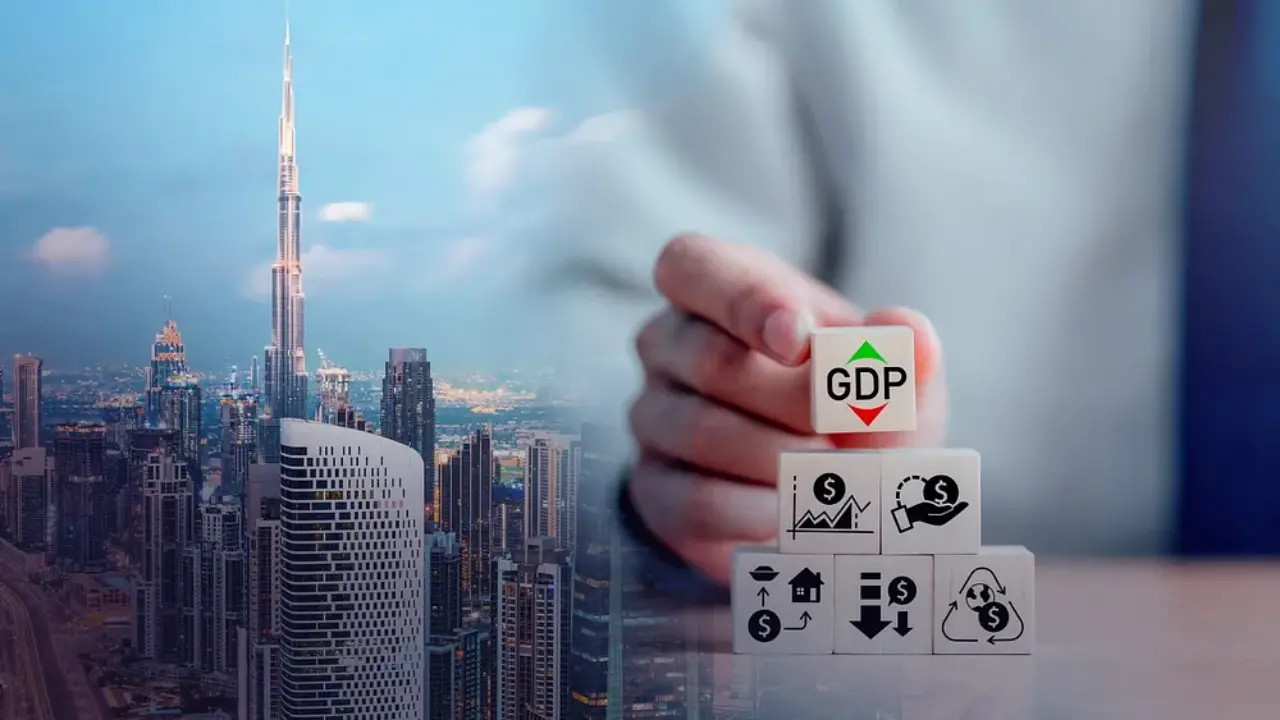
Dubai’s GDP reached AED 232 billion ($63.1 billion) in the first quarter of 2026, up 2.4% year-on-year, even as the wider UAE economy absorbs a downgraded IMF growth forecast tied to the Middle East conflict — a divergence that highlights Dubai’s increasingly diversified, non-oil economic model.
Dubai’s Q1 Growth Breakdown
Dubai’s Department of Economy and Tourism attributed the growth to the diversity and integration of the emirate’s economic activities alongside long-term development policies aimed at strengthening competitiveness, according to Arab News. Construction posted particularly strong growth, rising 8.2% to $5.1 billion, while finance and insurance expanded 6.5% to $8.8 billion and electricity and water grew 8.4% to $1.3 billion, according to Arabian Business. Wholesale and retail trade remained Dubai’s largest sector by output, reaching $13.9 billion after 2.6% growth.
This local resilience stands in contrast to the broader national picture: the IMF cut its 2026 growth forecast for the UAE as a whole by 1.9 percentage points to 3.1%, part of a wider downgrade across the Middle East reflecting the economic fallout from the US-Iran conflict, according to the same Arab News reporting.
Washington Eases Tech Export Restrictions on the UAE
In a significant parallel development, the United States is removing restrictions on the sale of advanced American technology and other sensitive goods to the UAE, effectively placing the Gulf state on par with Washington’s closest allies for access to controlled exports, according to AGBI. The move stands in sharp contrast to Washington’s simultaneous crackdown on chip-diversion routes through Singapore and Malaysia, underscoring how differently the U.S. is treating Gulf partners versus Southeast Asian transshipment points in the broader AI chip export control regime.
Gulf Wealth, Defense Spending, and the AI Investment Wave
Dubai has also reinforced its position as a global wealth hub, according to a Julius Baer report cited in Gateway Group’s weekly UAE business briefing. The same week saw Abu Dhabi’s Mubadala open a $25 billion credit arm to outside investors, UAE business activity forecast to accelerate in Q3 2026 according to Standard Chartered, and the UAE-Ukraine Comprehensive Economic Partnership Agreement formally enter into force on July 1. Global defense spending has also hit record highs, with the Gulf positioning itself as a stable haven precisely as instability elsewhere drives capital toward the region, alongside a broader “AI IPO wave” that Wall Street firms are increasingly courting Gulf sovereign capital to help fund, according to Arabian Business.
Non-Oil Diversification Strategy Paying Off
The UAE’s broader diversification strategy has matured considerably, with technology, green energy, and healthcare now the top-performing non-oil sectors nationally, according to analysis noted in Barchart’s economic outlook. Roughly 64% of UAE executives expect trade volumes to exceed 2025 levels, supported by the country’s expanding network of Comprehensive Economic Partnership Agreements, while infrastructure projects like the Etihad Rail expansion continue to create fresh logistics and technology opportunities.
What It Means for Global Investors
Dubai’s ability to post solid non-oil growth even as the national IMF forecast is downgraded for Middle East conflict risk suggests genuine structural diversification rather than simple oil-price dependency. Combined with the loosened U.S. tech export posture, Dubai and the broader UAE appear positioned to capture a disproportionate share of global AI infrastructure investment precisely as export controls tighten around competing hubs in Southeast Asia.
